Why Balance Is More Than Standing Still
Dynamic balance helps you turn and land with control. Learn what to notice in each movement and how to judge whether you are ready for the next action.
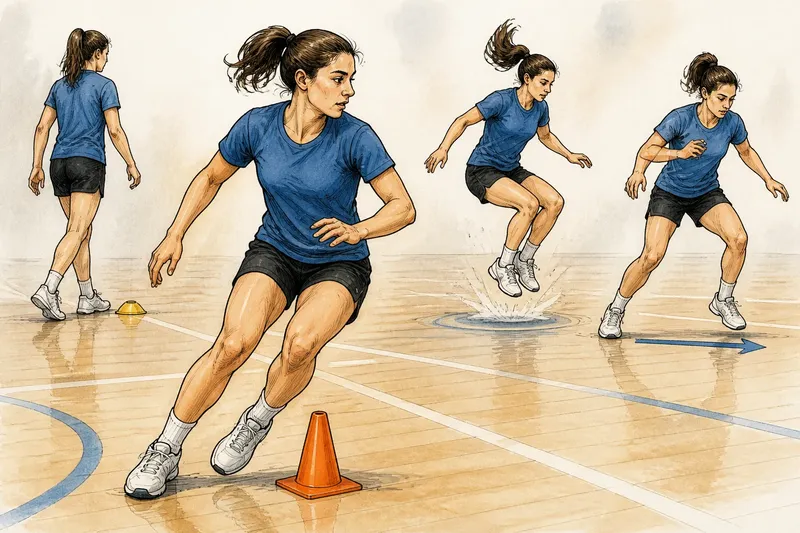
Dynamic balance is what lets you turn, land and move on without scrambling. On a court, that might mean planting a foot to change direction, or bending your legs after a jump so you can take the next step. The useful question is not whether you can hold a pose, but whether you can control the movement that follows.
A still stance can help you notice how your weight is distributed, but sport keeps changing the base beneath you. Practise familiar movements in a clear space and watch what happens after each turn or landing. Control should make the next action available.
What does dynamic balance mean in sport?
Your base of support changes as you move. With both feet planted, it is broad; during a running step or jump, it narrows or briefly disappears. Your body responds through the ankles, knees, hips, trunk and arms, shifting your weight towards a position that lets you continue.
Consider a player turning across a court. They may lower their hips, place a foot to the side and rotate their trunk towards the new path. After a jump, bending the knees and hips helps the player manage the landing and prepare for another movement. The timing of these adjustments matters as much as their visible shape.
Balance depends on the task. Standing comfortably does not automatically prepare you for a quick turn, and a two-foot landing does not cover every kind of landing. Practise movements your sport uses, starting with versions you can perform without rushing.
How does balance help you change direction?
A turn asks you to slow one path and create another. If your weight drifts beyond the foot you are relying on, the next step may feel hurried. Bending through your hips and knees can lower your body, while a deliberate foot placement gives you a base from which to push towards the new direction.
The useful position varies with your approach, surface and speed. Begin with a broad, predictable turn on an even, clear area rather than trying to copy a sharp game movement. Notice whether you can finish the turn and take the next step without shuffling or stumbling.
Say you are approaching a floor marker at a walk and your right foot lands far outside your body when you turn left. For the next repetition, slow your approach and choose a foot placement that lets your hips face the new path. The observable result you want is a completed turn followed by a steady step, not a particular-looking pose.
What should a controlled landing allow?
A landing is a transition, not a frozen finish. Your legs bend to manage the arrival, while your trunk and arms help keep your body organised. You should be able to tell where your weight is going and move again if the task calls for it.
Start with a small jump from two feet to two feet, using a clear, non-slip surface. Aim for a comfortable landing rather than height. If you feel awkward on arrival, replace the jump with a step down. When you can land comfortably, add one deliberate step in a chosen direction.
If that step leads to repeated hopping, twisting or loss of footing, remove it and return to the simpler landing. The point is to connect a landing with the next action, not to make the exercise difficult.
How can you build a week of balance practice?
Use the following sequence as a set of different movement choices, not a ladder you must climb. Before each session, check the surface, available space and how you feel. Choose a version you can finish in control; if a movement causes pain, dizziness or unusual instability, stop and seek appropriate advice.
- Walking and stopping: Walk forwards, stop, then walk again. If your weight keeps drifting to one side, shorten the walk or slow the stop; if you finish centred, continue with gentle side-steps.
- Broad turns: Walk towards a visible marker, turn around it and return. If your steps hurry or cross awkwardly, widen the turn or approach more slowly; if you can take a steady next step, repeat in the other direction.
- Landing and stepping: Make a small two-foot jump, land comfortably and take one step. If you twist or hop to recover, remove the jump and use a step down; if the landing and step stay controlled, try the same movement in the other direction.
- Easy movement: Choose familiar gentle activity, such as a walk, rather than repeating a movement that feels uncomfortable. If ordinary movement brings on pain or unusual instability, stop the session; if it feels comfortable, keep the pace easy.
- Turn and settle: Walk to a marker, turn around it and stop. If you need extra shuffling to settle, make the turn wider; if you stop under control, try a familiar landing-and-step at an easy pace.
- Sport-specific movement: Choose a familiar action, such as a gentle side-step followed by a return to your ready position. If you cannot return without scrambling, reduce the pace or omit the return; if you stay organised, repeat the action in the other direction.
- Review a turn and landing: Repeat one easy turn and one comfortable landing. If either feels less controlled than before, return to its simpler version next time; if both leave you ready for another movement, keep that level or change one feature slightly.
Imagine you have a clear, non-slip court, a floor marker and no pain or dizziness. You walk to the marker, turn left and notice that your feet shuffle before you can step away. You make the next turn wider and slower; this time you finish with one steady step, so you keep that version for practice. You then try a small two-foot jump and a step to the right, but the landing makes you twist. You replace the jump with a step down, land comfortably and take the same step. The result is a controlled turn at the easier pace and a step-down version of the landing; there is no reason to add speed or jump height yet.
How do you know when to change the task?
Look beyond the instant your foot touches the ground. After a turn, can you take the next step along your chosen path? After a landing, can you settle or move on without an extra hop? Those observations tell you more than trying to stand still for as long as possible.
Change one feature at a time. You might keep a broad turn and approach a little quicker, or add a step after a familiar landing without increasing the jump. If the change leads to scrambling, return to the earlier version. Make the next movement easier when control starts to disappear.
What do people ask about dynamic balance?
Can I practise balance without equipment?
Yes. A clear space and a visible marker are enough for walking, turning, stepping and small jumps. Avoid improvised unstable surfaces, which add difficulty without matching the movements in this routine.
Should I close my eyes to make practice harder?
No, not for turning or landing tasks. Keep your eyes open so you can judge the space and orient yourself towards a visible target.
What if one side feels less steady?
Use an easy version of the movement and practise both directions without forcing the less comfortable side. If the difference is new, painful or persistent, consult a qualified health professional.
How fast should I move?
Start at a pace that lets you finish each turn or landing in control. Increase the pace only when you can take the next step without scrambling.
What does dynamic balance let you do next?
Judge balance by the action it makes possible. A controlled landing leaves you ready to step; a controlled turn lets you travel along the new path. Dynamic balance practice is most useful when it connects those movements rather than rewarding a difficult-looking pose.
Choose one familiar turn and one modest landing, then notice which adjustment helps you continue. Keep dynamic balance practice at a level where the next action remains clear, and change only one demand when that control is consistent.